Jan 9, 2017


By Stephanie Simons,
Head Pharmacist,
Lindo’s Pharmacy in Devonshire
Every January many of us sit down and make commitments to ourselves and to each other about how we will better ourselves in the coming year. And year after year, many of these resolutions concern our weight and our overall health. But what do we need to do in order not only to make a real, positive change in our lives but also to stick to these resolutions? Here are some of my tried and tested tips.
One of the first steps in ensuring that you are at your healthiest is to make sure to get the vitamins that you need. If you are not already doing so, make a multi-vitamin part of your daily routine. I recommend Centrum, One-A-Day, Multibionta or one of the Vitabiotics products (Wellwoman and Wellman). Children can benefit, too, with child-friendly brands such as Flintstones, Yummi Bears, Wellkid or Rainbow Light. Making sure you get your vital vitamins will reduce your chances of sickness and can improve your energy levels.

Make a multi-vitamin part of your daily routine to supplement any nutritional deficiencies in your diet.
Another simple fix for your health and weight is to take stock of how much you are eating. What many people are guilty of, knowingly or not, is overindulging in their portion sizes. It is generally recommended that your plate should contain a mix of proteins, starch and vegetables. You should aim to make sure that your plate has an assortment of colours: get greens in your salad, orange and red in your carrots and beets and white meat on your plate, for instance. Your protein portion should be about the size of a deck of cards.
It is important to not only set goals for yourself, but to set realistic and perceivable ones: for instance, losing one to two pounds a week or reducing your cholesterol a certain number of points each month. This will give you something achievable and satisfying to work toward.
These small goals can also be more effective than bigger, more vague ones. Instead of pledging to drop three dress sizes in a year, promise yourself that you will exercise at least four times per week, or that you will have at least five portions of fruit and vegetables every day.
You can make small but significant changes to your everyday routine that will pay dividends over time. Some suggestions:
- Take the stairs rather than elevator whenever you can.
- Walking short distances rather than taking the car.
- Take healthy snacks to work with you and do not tempt yourself with unhealthy snacks by simply not buying them.
- Include at least one piece of fruit or vegetable with every meal.
- Drink water in place of sugary sodas.
Rule out absolutes: telling yourself that you will give up all unhealthy indulgences will only make you miserable in the short term and lead to failure in the long term. Allow yourself a ‘treat’ once a week, whether it be your favourite fish sandwich or a slice of chocolate cake. And remember, it’s much easier to exercise self-restraint if your favourite unhealthy snacks are not within reach: avoid having them in your cupboards or fridge.
One trick that you might find helpful is that if you feel an intense craving for something, make yourself wait for twenty minutes. You will be surprised how often the craving passes. If your sweet tooth absolutely won’t be denied, try a few squares of dark chocolate instead of more processed candy. Herbal and fruit teas can also help for when you need a little sweetness.
It is important whenever you make a lifestyle change to do so gradually: don’t starve yourself, don’t exhaust yourself. Remember that being your best self-means allowing yourself some happiness and enjoyment in life’s small pleasures.
Stephanie Simons is the head pharmacist at Lindo’s Pharmacy in Devonshire. She earned her Bachelor of Science in Pharmacy at Massachusetts College of Pharmacy and has been practicing for over 20 years. She is a registered pharmacist with the Bermuda Pharmacy Council and is a member of the Bermuda Pharmaceutical Association.
Dec 7, 2016
By Stephanie Simons,
Head Pharmacist,
Lindo’s Pharmacy in Devonshire
When we think of December we think of Christmas, twinkling lights and Dunkley’s eggnog – all the wonderful things that come with the season. However, as a pharmacist, “tis the season” also means the flu season! December marks the beginning of the peak flu season which runs through to the spring. That’s why we encourage flu vaccine awareness at this time of year.
I’ve previously covered the importance of keeping a flu survival kit and how to take care of yourself and loved ones during a bout of the flu, but I wanted to take some time to talk about the importance of the vaccine itself, how it works and what to do if you suffer from a fear of needles.
The flu vaccine works in the same was as many other vaccines, by introducing deactivated strains of flu viruses into your body. These deactivated samples cannot cause the flu because they have been neutralised. It is recommended that you get a vaccine for the flu every year, particularly if you are pregnant, have a chronic illness which suppresses your immune system, are over the age of 65 or under the age of five. The reason that you have to keep ‘renewing’ your vaccination is because the strains change all the time. Every year, the World Health Organisation holds a meeting in which they decide what the likeliest strains of flu will be in the coming year and these are the ones that you will be protected against in the vaccine.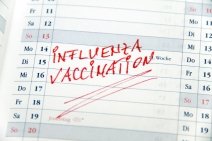
We all know that the flu jab is helpful and should be done every year, however, a huge number of people don’t take the opportunity to protect themselves. For some people, it’s because they simply don’t remember or think to do it. Therefore, it’s so important to make it part of your to-do list – even your list of things to get done before Christmas! This will ensure that you and your family have a merry Christmas and not a sick one.
A large percentage of people, though, avoid getting the flu vaccine for an entirely different reason: because they are afraid of needles. British and American experts have  suggested that as much as 10-20 percent of the population suffer from a phobia of needles, also known as trypanophobia. So, if you’re a needle phobic, you’re not alone!
Needle phobia can range from feeling panicked to fainting. There is no shame in being afraid of needles and the first thing to do when it comes to managing your fear is to be open about it. Tell your doctor or nurse that you’re not comfortable with needles and ask them to have patience, they will understand and can help you through the process.
Remember that the actual injection will be over very quickly. However, it is important to keep breathing throughout, deep and level breaths. It will help to position yourself so that you can look away from the needle and many find it useful to have someone with them to talk to, or even listen to music on their phone. Children may benefit from having a tablet with a game or video on. These will provide something to focus on and distract from the jab.
Take a snack, ideally, a healthy one such as a banana or other piece of fruit, to eat after the injection to help with any light-headedness that you may experience. You should remain seated for as long as you need and if you feel unwell, make sure you have someone drive you home. Some people may experience muscle aches or a slight temperature in the aftermath of their injection, but this shouldn’t be confused with getting a cold or flu. Take it easy and treat yourself to a hot bath or shower afterward to relax. The greatest incentive, though, should be to get yourself through the holiday season flu-free to spend time with family and friends.
From everyone at Lindo’s, we wish you a Merry Christmas and a Happy New Year.
Stephanie Simons is the head pharmacist at Lindo’s Pharmacy in Devonshire. She earned her Bachelor of Science in Pharmacy at Massachusetts College of Pharmacy and has been practicing for over 20 years. She is a registered pharmacist with the Bermuda Pharmacy Council and is a member of the Bermuda Pharmaceutical Association.
Nov 7, 2016
By Stephanie Simons,
Head Pharmacist,
Lindo’s Pharmacy in Devonshire
November is Stress Awareness Month so I thought I would take some time to address stress and how we can best manage it.
“Stress” has become a word that we all throw around but we sometimes forget the true meaning of it. I’m sure we’ve all told our friends that we’re a bit stressed and laughed it off. But despite the flippant way that we might refer to it, stress is a real problem for a lot of people and it can have serious repercussions.
Those who live with prolonged stress put themselves at risk for a number of health problems, including:
- Fatigue/exhaustion
- Irritability
- Poor concentration
- Difficulty sleeping
- Aches and pains
- Headaches
- Stomach and digestive problems
Stress can be caused by any number of things, whether it is work pressure, financial concerns, relationship issues or a high-pressure event looming. There is even evidence to suggest that not getting enough magnesium or vitamin B can cause stress. (more…)
Oct 12, 2016
By Stephanie Simons,
Head Pharmacist,
Lindo’s Pharmacy in Devonshire
After a summer outdoors in the sun and surf, children have gone back to school. While the weather might still be warm, many parents may be worrying about the cold – the common cold, that is.
Back in the playground, playing with friends they haven’t seen all summer, our children seem to have a knack for picking up bugs at the start of the new school year. Pharmacists are often asked about the best ways to prevent a cold and how to treat it, once the inevitable occurs, so here are some of my thoughts.
Prevention
During the summer holidays, many children enjoy staying up later than they would normally. It is important to ensure that children get enough sleep. The Sleep Foundation recommends that pre-schoolers should have between 10-13 hours of sleep and 6-13 year olds should get 9-11 hours. Uninterrupted, restorative sleep will ensure that your child’s immune system is working at its best.
We always recommend a healthy and well balanced meal, with plenty of vitamin C and zinc to prevent illness. However, for anyone concerned that their children might not be getting all the nutrients they need, vitamin supplements are an option. Many children dislike taking tablets, which is why chewable and gummy vitamins, such as Flintstones, Yummi Bears Rainbow Light Kids One are so popular. Some brands – Yummi Bears, Rainbow Light and Lil Critters for example – are also free of artificial sweeteners and colours and are gluten-free if those are concerns.
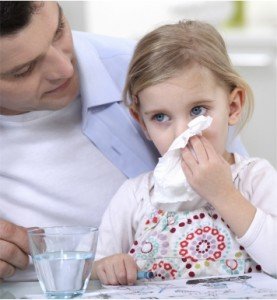
When children are unwell they often feel frightened or worried. Lots of attention and cuddles go a long way to reassure and soothe them.
The beginning of the school year is a good time to revisit the topic of hygiene with your young ones. Going over the following steps is an easy way to help your child to reduce their chance of catching something – and to make sure they don’t pass anything on!
- Wash your hands regularly with soap, particularly before you eat or after you’ve blown your nose. Little bottles of hand sanitizer can help with this.
- Cover your mouth with a tissue – or even your elbow! – when sneezing or coughing.
- Don’t share food, utensils, glasses or straws with anyone else.
- Throw used tissues away immediately.
Dealing with a cold
Symptoms of a cold usually come on quickly over a day or two. Colds, as you will undoubtedly know, are extremely contagious. They are spread in water droplets that are expelled through breathing, coughing, sneezing or even laughing! That’s why it’s important to have a healthy supply of tissues and hand sanitizer available especially when hand washing is not possible.
The first thing to do, if your child has contracted a cold, is to keep them at home until they feel better. While we all want to keep sick days to a minimum, doing this will accelerate their recovery and will help to minimise the spread of the bug across the playground. The other parents will thank you, as will the teachers!
Rest, as with prevention, is extremely important when recovering from a cold. Additionally, your child should drink plenty of fluids: dehydration will exacerbate symptoms and slow down recovery.
In terms of medication: there is no cure for the cold, but there are medicines which will mask some of the symptoms. For sore throats, you may find throat lozenges such as Chloraseptic, Sucrets o
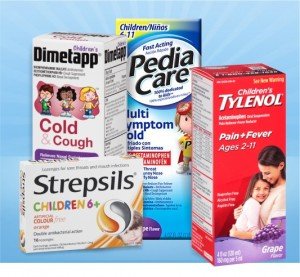
Always read the package label and follow directions carefully. Many of these medicines contain several drugs. If you’re giving a cold medicine to your child that has a painkiller or decongestant in it, make sure you don’t give him more of those separately. Too much medicine could be risky.
r Strepsils will provide some comfort for older children. Gargling with salt and warm water is also helpful. Headaches and sore muscles can be alleviated with ibuprofen (Advil) or acetaminophen/paracetamol (Tylenol or Calpol).
There are specific cold medicines, such as PediaCare for colds, cough or flu, Children’s Robitussin and Dimetapp which will help with congestion and all round cold symptoms. However, caution should be exercised when using multiple products as many often contain acetaminophen (paracetamol) which makes it easy to accidentally double up. The majority of these over-the-counter cold medicines should not be taken by children under six years old. Please speak to your pharmacist or doctor if you’re unsure about what you should be taking.
When your children have the sniffles, it’s easy for them to feel down, but most people are back to good health within ten days. Just remember to take it easy, have lots of cuddles and they’ll soon be back on their feet.
Stephanie Simons is the head pharmacist at Lindo’s Pharmacy in Devonshire. She earned her Bachelor of Science in Pharmacy at Massachusetts College of Pharmacy and has been practicing for over 20 years. She is a registered pharmacist with the Bermuda Pharmacy Council and is a member of the Bermuda Pharmaceutical Association.
Sep 6, 2016

By Stephanie Simons,
Head Pharmacist,
Lindo’s Pharmacy in Devonshire
For many parents, students and teachers, the night before school begins feels more like New Year’s Eve than December 31st does. Schedules are made, goals are set and a routine begins to develop. While many students look forward to reconnecting with friends and joining clubs or teams, for others, returning to school can elicit feelings of fear, nervousness and anger. Whether you are a parent of a child starting school for the first time, or have a  child in middle or senior school, there are ways to make the return to school a positive experience.
Communication
Talk to you child and ask if he or she has any concerns about starting or going back to school. Try to have a conversation when you have plenty of time to listen and can give your child your full attention. Teenagers may feel more comfortable confiding in you if direct eye contact isn’t forced, so a chat during an activity or while in the car may be appropriate.
Common fears about school are often performance related or centre on feelings of inadequacy. Students may worry about fitting in, being late, making mistakes, being chosen last or earning good grades. Rather than saying “don’t worry” or another platitude, try to encourage your child to figure out what scares them the most and have them brainstorm solutions. Help them set realistic expectations. This type of preparation may lessen the fear or help them to deal with it better.
Prepare younger students by reading stories that feature schools as the setting or subject – just make sure the book has a positive, happy ending! Younger students may also benefit from role playing. You can role play the drop off and pick up from school, or act out how to approach other children on the playground. You can also practice being apart from your child (via play dates, lessons, or going out with your spouse). Your child will see that he or she is OK when you’re not around and will have a positive frame of reference.
De-Stress the morning
Whatever can be done the night before, do it! This includes laying out clothes for the next day and preparing snacks and lunches. The less stress a parent has in the morning, the more likely he or she will be able to stay calm and patient when encountering a child who is resisting going to school that day.
Designate a particular space in your home for storing backpacks and school supplies so that your child can quickly locate what he or she needs to grab before heading out the door.
 Create a morning routine that works for your family. This could be as simple as writing instructions on a piece of paper listing steps that need to be completed before going to school or picture reminders on index cards for small children who are not yet avid readers.
If mornings are typically a rush in your home, skip a hot breakfast and try out some healthy recipes posted on the Lindo’s website, including Yogurt Breakfast Bowls, Savoury Breakfast Muffins (made in advance) and Blueberry Pomegranate Smoothies. For a quick cereal option, you may want to try Nature’s Path organic breakfast cereals or another protein rich boxed cereal. A healthy breakfast will give students the energy that they need in order to focus and learn.
Bedtime
Summer often invites later bedtimes, but upon the return to school, you may want to establish a calm routine at night. Something as simple as a bath followed by story time may help set up a calm environment for children to fall asleep. It can also provide a great time to have a chat about good things that happened during the day. A well rested child will be able to cope better with change or fears than a tired, cranky child. Sleep also helps us retain information and benefits our overall health.
Avoidance
Most of us feel a little nervous during periods of change or transition. It’s normal! Children will naturally want to avoid situations that make them uncomfortable, but it is important to encourage your child to name and face their fears. If children are permitted to stay home from school, it may reinforce their fears. Instead, try to prepare them for what to expect, reinforce positive behaviours and reward their effort. Rewards can be anything from a positive comment and a hug, to a special activity after a certain number of successes.
 When it’s more than just the jitters
The World Health Organization reported that 10-20% of children and adolescents experience mental health disorders, with 50% of these beginning by the time they reach age 14. If your child demonstrates upset feelings about school with ongoing intensity and frequency, he or she may have more that back to school jitters. Children with anxiety will often complain of physical symptoms too, including headaches and sore stomachs. Anxiety about school can interfere with daily activities and make seemingly simple tasks frustrating. A medical professional may recommend cognitive behaviour therapy in order to cope with anxiety. This could include practising belly breathing, muscle relaxation and positive self-talk. Anxious children will benefit from a strong support system, so be sure to relay your concerns to your child’s teacher and principal.
Self Care for Parents
It is easier to be calm and patient when you have taken time to care for yourself, too. Carving out time for a walk with a friend, eating well and getting enough sleep will go a long way in being able to care for a child with anxious feelings. Consider naturally scented bath products (Dr, Bronner’s has an extensive line) and take a soak in your tub. Remember that popular quote, “you can’t pour from an empty cup!”
Stephanie Simons is the head pharmacist at Lindo’s Pharmacy in Devonshire. She earned her Bachelor of Science in Pharmacy at Massachusetts College of Pharmacy and has been practicing for over 20 years. She is a registered pharmacist with the Bermuda Pharmacy Council and is a member of the Bermuda Pharmaceutical Association.
Aug 9, 2016
By Stephanie Simons,
Head Pharmacist,
Lindo’s Pharmacy in Devonshire
With the increasing number of displays of notebooks, pencils, back packs and lunch bags popping up across stores in Bermuda, a not so subtle hint reminds parents and students alike that a new school year is approaching. While preparing a list for back to school shopping, you may want to consider one additional task — scheduling a routine eye exam for your child.
Most educational environments are structured to support visual learning, engaging students to learn through watching demonstrations, reading books, using the computer, interpreting pictures they see and engaging with visual materials. Eye health is certainly a consideration in this environment! Healthy eyes also help children to actively participate in sports and other extra-curricular activities.
The UK National Screening Committee recommends screening children between the ages of four and five for visual impairments. Likewise, the American Optometric Association encourages parents to schedule a comprehensive eye exam for their children at age three, then again before starting school.
Common Symptoms of Eye Problems
Parents and caregivers can be on the lookout for several common symptoms affecting vision in young children, including:
- chronic redness or tearing
- routinely sitting too close to a television or holding a book very close to his or her face
- favouring one eye over the other
- a wandering eye
- tilting or turning his or her head to look at objects
- holding objects at a great distance
- frequently squinting or rubbing his or her eyes
A number of factors contribute to overall eye health, from a healthy environment and balanced food choices, to wearing protective eye gear during sports and outdoor activities.
Common Irritations
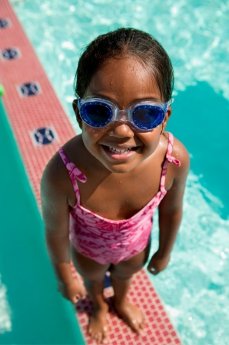
Eye discomfort is a common complaint following children swimming in the ocean or in a pool treated with chlorine. Red or itchy eyes may also be the result of allergies, or sand or dust getting into their eyes. Parents can ease their child’s discomfort by rinsing their eyes with lukewarm water from a tap or jug or eyewash like Optrex, or using an artificial tear solution made from pure saline. To prevent irritation during swimming, wearing goggles will often suffice, and provide the fun benefit of seeing what is on the ocean or pool floor!
If an object gets lodged in a child’s eye, such as a glass shard or splinter, parents should seek immediate help from a trained health professional. Attempting to remove this type of debris could result in damage to the eye, especially the cornea.
 Protecting Vision
Protective eye gear made from polycarbonate, a highly impact-resistant plastic, makes many sports and activities safer for our children’s eyes. If your child participates in a sport involving a ball, stick, racket, puck or other projectile object, you may want to consider investing in this eye gear.
Sunglasses afford eye protection from harmful UVA and UVB rays that can damage the eyelid, lens and cornea, sometimes leading to the development of cataracts. When purchasing new shades, look for a label that indicates they block 99-100% of UVA and UVB rays and ensure they properly fit your child.
Eye injuries can also be prevented by keeping chemicals out of reach of children, especially fertilizers, pool chemicals, cleaning agents and pesticides.
Healthy Eating
When it comes time for snacks and meals, providing your child with a diet rich in fruits, vegetables and legumes will have a positive impact on their eye health.
When packing their lunch boxes, consider adding dark, leafy greens (kale, spinach, collard greens), which are high in lutein and zeaxanthin, and may lower the risk of age related macular degeneration and cataracts. Foods such as salmon, tuna, halibut and sardines contain Omega-3 fatty acids, and can reduce the risk of eye diseases later in life. If your child isn’t a fan of fish, many Omega-3 vitamin supplements are on the market. Foods high in zinc can protect from the damaging effects of light, and is easily sourced in black eyed peas, kidney beans, lima beans and peanuts. Citrus fruits, often a crowd pleaser with children, contain antioxidants, and also benefit our eyes.
When shopping for back to school supplies, consider a reusable water canteen. Just like the rest of our body, our eyes depend on hydration. Drinking an adequate amount of water will help produce tears, preventing dry eyes and allowing for debris to be washed away as we blink.
Preventing tears caused by the return to school, however, is a whole other article!
Stephanie Simons is the head pharmacist at Lindo’s Pharmacy in Devonshire. She earned her Bachelor of Science in Pharmacy at Massachusetts College of Pharmacy and has been practicing for over 20 years. She is a registered pharmacist with the Bermuda Pharmacy Council and is a member of the Bermuda Pharmaceutical Association.