Apr 3, 2022
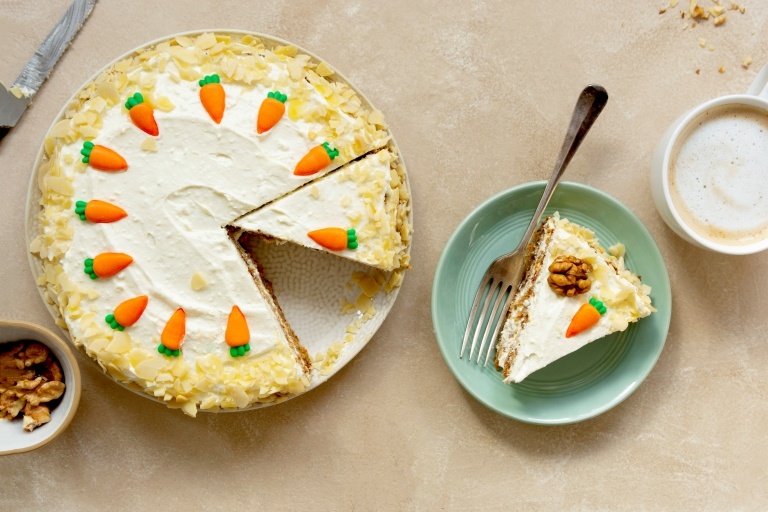
This easy 2-layer carrot cake recipe is made with fresh carrots, and raisins and is topped with a fluffy cream cheese frosting. It is the perfect dessert for Spring and Easter celebrations.
Prep Time: 20 mins ■ Cook Time: 45 mins ■ Total Time: 1hr 5 mins
INGREDIENTS
Cake
- 2 cups all-purpose flour
- 2 teaspoons baking soda
- 1/2 teaspoon salt
- 1 1/2 teaspoons ground cinnamon
- 1 ¼ cups vegetable oil
- 1 cup granulated sugar
- 1 cup lightly packed brown sugar
- 1 teaspoon vanilla extract
- 4 large eggs
- 3 cups grated carrots (about 5 carrots – washed, peeled, and dried)
- 1 cup coarsely chopped pecans
- 1/2 cup regular or golden raisins
Cream Cheese Frosting
- 1 cup unsalted butter softened (2 sticks)
- 2 – 8-ounce packages cream cheese, room temperature
- 8 cups powdered sugar (confectioners’ sugar)
- 1 tablespoon milk
DIRECTIONS
- Heat the oven to 350°F. Prepare two 9-inch round cake pans. Place your cake pans on a large sheet of parchment paper. Trace the bottom of each cake pan with a pencil, then cut out the traced circles. Lay the cut parchment circles at the bottom of each pan. Grease the pan and the parchment paper.
- In a medium bowl, whisk together flour, baking soda, salt, and cinnamon until well blended.
- In a separate bowl, whisk the oil, sugar, and vanilla. Whisk in eggs, one at a time, until combined.
- Scrape down the sides and bottom of the bowl with a spoon or spatula, then stir in the dry ingredients a little at a time, until incorporated and the batter is smooth. Stir in the grated carrots, nuts, and raisins.
- Divide the batter between the prepared cake pans. Bake for 35-45 minutes, or until a toothpick inserted into the center of the cake comes out clean.
- Cool cake in pan for 15 minutes, then carefully invert onto a cooling grid and cool completely before decorating.
- In a large bowl, beat butter and cream cheese with an electric mixer until light and fluffy.
- Gradually add confectioners’ sugar and milk to the butter and cream cheese. Beat on high until smooth (about 1 minute). Note: If frosting seems too thin, add 1 tablespoon of confectioners’ sugar at a time. If too thick, add 1 teaspoon more of milk at a time until frosting reaches desired consistency.
- Frost the top of one cake layer, and place the other cake layer on top. Frost the outside and top of the cake. Carefully scatter the slivered almonds on the sides of the cake and on the outside perimeter (about 2 inches) of the top of the cake. If desired, pipe on carrot decorations. Find out how at wilton.com
Add-ins: For even more delicious flavour, you can add 1 (8-ounce) can crushed pineapple, drained and 1 cup sweetened flaked coconut along with the grated carrots, nuts, and raisins in step 4.
To store: An uncut carrot cake will keep for about 1 week in the refrigerator. If it has been cut, it will stay fresh in the refrigerator for roughly 2 to 3 days.
Mar 17, 2022

By Stephanie Simons,
Head Pharmacist,
Lindo’s Pharmacy in Devonshire
The body’s largest organ is the skin. Just as crucial as the heart or brain, our skin protects the rest of the body from the external world, from harsh temperatures to harmful bacteria. However, it isn’t without its own vulnerabilities. Whether we’re battling skin disease or worried about premature ageing, it’s critical that we understand our skin – and how to take care of it.
Structure
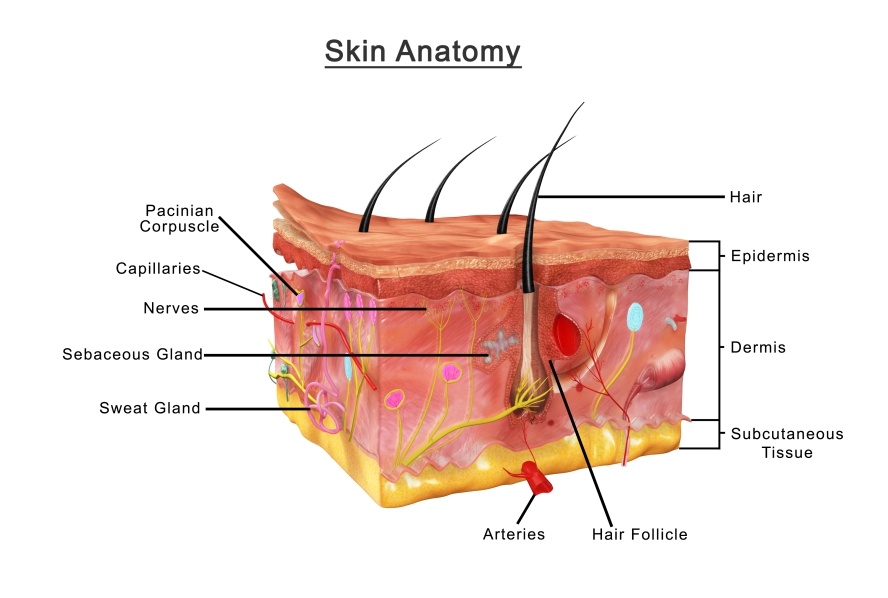
Our skin is made up of three layers, the epidermis, subcutis, and dermis.
Keratinocytes are the main building blocks of the epidermis and produce the protein keratin. The epidermis is also home to sweat glands, sebaceous (oil) glands, hair follicles and melanocytes which produce a pigment called melanin that protects us from UV rays.
Below the epidermis, the subcutis – or hypodermis – is made up of fibrous tissue and adipose (fat) and varies according to your size and weight. The dermis underneath is much thicker. Formed of collagen and elastin, it insulates the body while cushioning it against external trauma.
Function
The skin is not only the biggest organ, but also one of the most important, with several critical functions.
Its main function is to prevent water loss and shield the body from physical and chemical harm. A key part of the immune system, the skin fights off bugs, allergens and other toxins in our surroundings. It also enables the absorption of Vitamin D from sunlight, helping our bodies protect against numerous diseases like osteoporosis and cancer.
The skin enables our sense of touch so we can interact with the physical world, sense danger and injury, and enjoy pleasurable sensations. It’s also key in terms of physical attraction. The skin’s appearance, texture and quality play a significant role in our perception of health and beauty, though this tends to vary across cultures.
Skin care
Taking care of our skin is good for bodily health and our appearance. A simple, consistent routine can keep your skin comfortable and healthy while more advanced products can tackle a wide range of issues, from acne and pigmentation to wrinkles and collagen loss.
To maintain general skin health, it’s important to wash your face morning and night. For oilier skin types, try a face wash like Neutrogena Oil-Free Pink Grapefruit wash or scrub, while dry or sensitive skin might prefer a creamy cleanser like Cerave Hydrating Cleanser. Reinforce your skin’s barrier function with a layer of moisturiser – Cerave Facial Moisturiser AM and PM formulas are a great all-rounder, and Eucerin works wonders for sore or dehydrated skin. In the daytime, be sure to apply – and reapply – sunscreen of SPF 30+ such as Neutrogena Daily Moisture or Cerave AM Moisturiser lotion. This greatly lowers risk of skin cancer and helps prevent premature ageing.
There are a few key ingredients that can help you get even better results. For anti-ageing, there’s nothing better (and more scientifically proven) than Vitamin A, ranging from over-the-counter retinol products like Neutrogena Rapid Wrinkle to full strength tretinoin available only on prescription. Whatever strength, these products can irritate skin if used too often – start once a week and build up from there.
For spots or acne, a helpful ingredient is Salicylic Acid, an exfoliant that dives deep into pores and clears them out. Try a cleanser like Neutrogena Acne or Cerave Acne or a targeted spot treatment like Neutrogena Rapid Clear or Neutrogena Stubborn Marks. Products containing antioxidants like Vitamins C and E can also help protect your skin from external aggressors – try applying a serum like Avalon Organics Intense Defence Vit. C Face serum before your moisturiser.
Inside and out
You can also support your skin through your diet. Vitamin D plays a key role in building healthy skin cells: try oily fish, mushrooms or a supplement like Olly Glowing Skin Gummies or Alive Hair, Skin and Nails. Vitamin C can help to repair skin and retain its moisture. Citrus fruits, broccoli, and supplements like Nature’s Bounty Vit. C can boost your levels. Reducing your sugar intake is also proven to significantly improve your skin.
We’ve come a long way in understanding the skin and how to care for it. If you’re worried about your skin or simply want to make sure it is healthy, you can always talk to your GP or pharmacist. By protecting your skin, you’re protecting your whole body.
Stephanie Simons is the head pharmacist at Lindo’s Pharmacy in Devonshire. She earned her Bachelor of Science in Pharmacy at Massachusetts College of Pharmacy and has been practicing for over 20 years. She is a registered pharmacist with the Bermuda Pharmacy Council and is a member of the Bermuda Pharmaceutical Association.
Feb 22, 2022

The Bermuda Diabetes Association is putting on their walking shoes once again for the upcoming ‘Walk to Defeet Diabetes’ in collaboration with Lindo’s Group of Companies. Stronger than ever and with the experience from years past, this is a fantastic virtual event where you can walk, run or jog, in your own time, from March 18-20 throughout scenic and historical St. George’s Parish.
T-Shirts and goodie bags for the first 500 participants. For pickup times and more information visit: www.diabetes.bm
Sign up today and be part of the change!
Feb 9, 2022
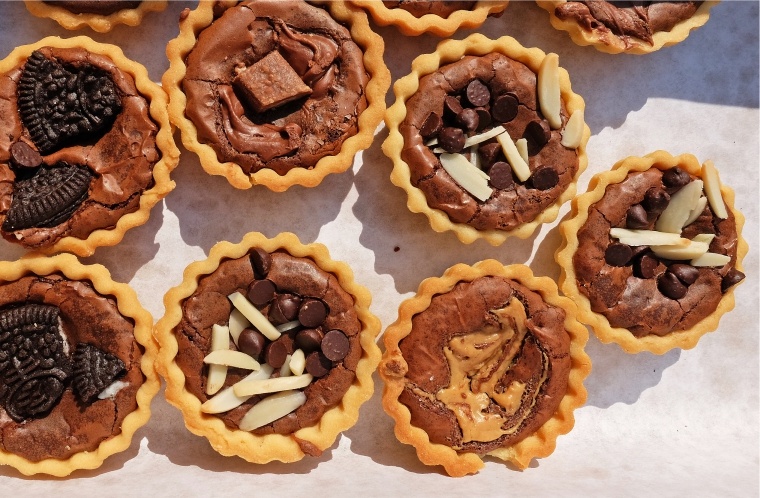
Alone, or topped with your favourite sweets or nuts, these Fudge Brownie Tarts hit the sweet spot. They’re flaky, chocolatey, and delicious!
Prep Time: 40 mins • Bake Time: 20 mins • Makes: 16 tarts
INGREDIENTS
Buttermilk Tart Shell Crust
- 2 cups + 2 tablespoons all-purpose flour
- 1 tablespoon granulated sugar
- 1 teaspoon salt
- 2/3 cup cold butter
- 5–7 tablespoons cold buttermilk
Brownie
- 1/2 cup unsalted butter
- 1 1/2 cups granulated sugar
- 1/2 cup unsweetened cocoa powder
- 2 large eggs
- 1 teaspoon pure vanilla extract
- 3/4 cup all-purpose flour
- Toppers – caramel, Oreo cookie pieces, mini chocolate chips, etc., optional
DIRECTIONS
- Place the flour, sugar, and salt in the bowl of a food processor, stand mixer, or in a medium mixing bowl.
- Pulse/stir/cut in the butter with a pastry blender, until the mixture resembles coarse meal.
- Add buttermilk 1 tablespoon at a time and combine dough until the mixture leaves the sides of the bowl.
- Form dough into a ball, then, on a floured surface, flatten it into a disk shape. Cover with plastic wrap and allow to chill in the fridge for 30 minutes.
- Heat the oven to 375°F.
- In a large bowl, melt butter in the microwave on HIGH for 30 seconds, stir and repeat if necessary until most of the butter is melted.
- Whisk in sugar and cocoa. Add eggs and vanilla and mix well. Fold in the flour until it is completely blended into the cocoa mixture. Set aside.
- Take the dough out of the fridge and remove the plastic wrap.
- Using a rolling pin, on a floured surface, roll the chilled dough to 1/8-inch thick.
- Using a round or fluted cookie cutter, cut out circles of pastry. The larger the circles, the deeper the tart shells will be. They should be at least as wide as the opening of muffin pan holes. Gently slide the circles of cut pastry into each muffin hole. Carefully press on the edge between the bottom and the sides to make sure there are no air bubbles stuck between the pastry and the pan.
- Fill each tart shell three-quarters full of the brownie mixture.
- Bake for 15 to 20 minutes or until a toothpick inserted in the center comes out clean.
- Take out of the oven and immediately sprinkle with chocolate chips, caramel pieces, or gently press cookie pieces into the brownie whilst still hot.
- Allow to cool for 2 minutes in the pan then gently remove to finish cooling on a wired rack.
Feb 9, 2022
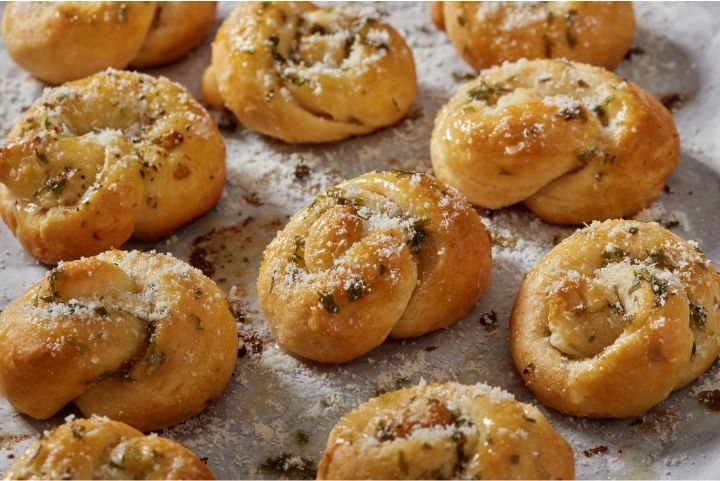
Slathered in garlic, herbs, and Parmesan cheese, these Garlic Parmesan Knots are easy to make using refrigerated biscuit dough.
Prep Time: 5 mins • Cook Time: 10 mins • Makes: 16 knots
INGREDIENTS
- 1 -16 oz. can refrigerated biscuit dough
- 1/4 cup unsalted butter, melted
- 2 1/2 Tbsp. grated parmesan cheese
- 3/4 tsp. garlic powder
- 1/2 tsp. dried oregano
- 1/2 tsp. dried parsley flakes
- 1/4 tsp. salt
DIRECTIONS
- Preheat oven to 400°F and line a baking sheet with parchment paper, or lightly grease pan.
- Cut each of the 8 biscuits in half, making 16 pieces of dough.
- Roll each biscuit into a rope, 1/2 inch thick, and tie them into a knot.
- Place each knot onto a prepared baking sheet.
- In a small microwave-safe bowl, melt butter. Add parmesan cheese, garlic powder, dried oregano, dried parsley, and salt. Whisk to combine ingredients well.
- Brush each knot with half of the garlic butter mixture and place in a preheated oven for 10-12 minutes or until golden brown.
- Remove from oven and brush garlic knots with the remaining garlic butter mixture. Serve immediately.