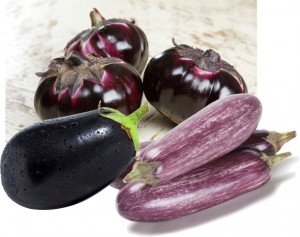
That’s right! Aubergines, or eggplant as they are more commonly called in Bermuda, are not a vegetable at all – they’re berries! The fruit is botanically classified as a berry and contains numerous small, soft seeds which are edible but bitter tasting. Eggplant grows very similar to tomatoes, hanging from the vines of plants that grow several feet in height. There are many different varieties of eggplant and the colours range from deep-purple, to lavender, green, orange, white and striped. The inside flesh of an eggplant is cream colored, spongy in consistency, and meaty in texture.
Eggplant belongs to the plant family of Solanaceae, also commonly known as nightshades, and are closely related to the tomato, bell pepper and potato. Unlike most fruits, it isn’t recommended eating eggplant without cooking it beforehand. Although eating raw eggplant is certainly not dangerous, the seeds do contain bitter tasting nicotinoid alkaloids. Like many other members of the nightshade family, eggplants are also related to tobacco. However, the amount of nicotine in eggplant is quite negligible. In fact, you would have to eat between 20 to 40 pounds of eggplant to equal smoking one cigarette.
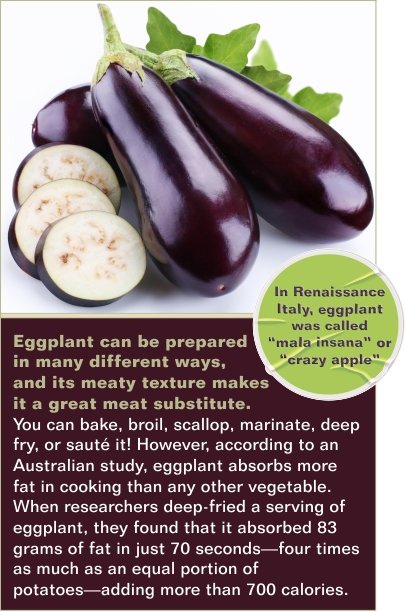
Eggplant becomes very tender when cooked and develops a rich, complex flavor. Salting and then rinsing the sliced eggplant (known as “degorging”) can soften and remove much of the bitterness of the seeds (some modern varieties do not need this treatment, as they have been hybridized to eliminate bitterness). In addition, the salting process will reduce the amount of oil absorbed during cooking as eggplant is capable of absorbing large amounts of cooking fats and sauces. Unless desired, peeling the skin of eggplant is not necessary as it is also edible.
Aubergine, or eggplant, is popular in many Mediterranean countries. The Greeks have a classic dish using eggplant called Moussaka. Moussaka is a casserole made by layering eggplant with a spiced meat filling then topping it off with a creamy bechamel sauce that is baked to golden perfection.
In Italy, Eggplant Parmesan is a staple of traditional Italian cooking. Originating from Southern Italy, Parmigiana di Melanzane, (as is called in Italian) is a casserole dish that uses fresh eggplants, tomato sauce, and mozzarella and parmesan cheese. The dish requires very few ingredients but it is a rich and satisfying recipe. Although typical eggplant parmesan dishes require the eggplant to be fried before layering, grilling eggplant makes it much healthier, and it’s just as tasty.
Eggplant is a fat free, low-sodium food that is high in fiber and low in calories, and a good source of vitamin C, calcium and potassium. A one-cup serving of raw eggplant is only 20 calories!
Eggplants are extremely temperature sensitive, and can perish quickly in too warm or cold temperatures. Ideally, eggplant should be stored at 50°F which can be difficult to achieve in Bermuda’s climate. If you cannot use immediately after purchasing, store eggplant in the vegetable compartment of your refrigerator at 45 to 50°F. The vegetable compartment has higher humidity than other areas in the refrigerator and is preferred for eggplant storage. If storing in other areas of the refrigerator wrap eggplant loosely in plastic wrap. Use within 3-5 days of purchase.
• An eggplant is almost ninety-five percent water.
• Eggplant is native to Southern India and Sri Lanka.
• Common names for eggplant around the world are aubergine, eggplant, brinjal, garden egg, patlican, and guinea squash.
• The word “eggplant” comes from British-colonized India, where at the time, a small, white, egg-like variety of the vegetable was extremely popular.
• A Japanese proverb says, “The happiest omen for a New Year is first Mount Fuji, then the falcon, and lastly eggplant”.
Mango is a tropical fruit that comes in as many as 1,000 varieties. Native to southern and southeast Asia, the fruit is now is also grown in Central and South America, Africa and the Arabian peninsula.
Mangoes are seasonal fruits, with the fresh mango fruit season beginning in May. Mangoes are usually harvested while they are green but perfectly mature. Unripe mangoes are extremely sour.
Known worldwide as the king of fruit, mangoes are an incredibly healthy snack, and are considered one of the most nutrient-dense fruits. Mangoes are high in fibre, Vitamin C, Vitamin B6, Potassium, Copper and Vitamin A and other importantphytochemicals. Mangoes also contain beta-carotene which may help slow the aging process, reduce the risk of certain forms of cancer, improve lung function, and reduce complications associated with diabetes. Virtually fat-free and low calorie, it is easy to see why tropical mangoes are considered a super fruit!
To learn more about mangoes, and dig up some more interesting trivia visit www.mango.org
Whether you are at the game, boating, beaching, hanging out in the backyard, or just chilling in front of the television – we wish you a safe, and enjoyable Cup Match holiday!
Both Lindo’s stores will be CLOSED for the holiday on Thursday, August 2nd and Friday, August 3rd and will be OPEN for business on Saturday, August 4th from 8:00am until 8:00 pm.
“Citius, Altius, Fortius” – translated Faster, Higher, Stronger is the Olympic motto. The words embrace the hard work and commitment of athletes the world-over. The words challenge every individual to be the best that they can.
We believe in the Olympic Spirit which is best expressed in the Olympic Creed: “The most important thing in the Olympic Games is not to win but to take part, just as the most important thing in life is not the triumph but the struggle. The essential thing is not to have conquered but to have fought well.”
We believe in bringing people together in peace and friendship to play sport.
We’re cheering on our Team Bermuda athletes and wish them all every success at the 2012 Olympic Games in London.
EMBRACE THE OLYMPIC SPIRIT! GO TEAM BERMUDA, GO!!!
Want to add taste, color and crunch to salads any time of the year? Then sprinkle on pistachios. Chefs are going nutty over them, and for good reason.
California grown, these pale green nuts have a subtle, delicate flavor that is wonderful in sweet as well as savory dishes or for eating out of hand. Traditionally used in rice dishes, stuffing, ice cream and pastries, pistachios are now a key ingredient in signature salads.
The key to including nuts in the diet without adding extra calories is portion control. Use pistachios on salads, or in main dishes, to replace meat or poultry. California pistachios have versatility, texture and great taste. They also pack a powerful nutritional punch. A 1-ounce serving – 49 pistachios – contains more than 10 percent of the Daily Value for dietary fiber, vitamin B-6, thiamin, phosphorus and copper. One serving of pistachios has as much potassium as half a large banana. Pistachios contain mostly monounsaturated and polyunsaturated fat (11 of 13 fat grams), the types of fat recommended by the 2005 Dietary Guidelines For Americans. Pistachios also are naturally cholesterol free and trans fat free.
What makes gazpacho soup so good is the fresh taste of all the vegetables. It’s best in the summer when vegetables are the most flavorful. People who have never tried a cold soup are sometimes hesitant to try gazpacho but soon become fans of the fresh, intense flavors. Gazpacho is one of summer’s pleasures!
Gazpacho soup originated from the southern Spanish region of Andalusia. Although there are many regional and modern versions of this recipe, it’s traditionally made with ripe tomatoes, bell peppers, cucumbers, garlic, and bread moistened with water that is blended with olive oil, vinegar, and ice water and served cold.
Gazpacho was traditionally eaten by workers in the fields of vineyards, olive plantations, citrus groves, wheat fields, or cork farms. Gazpacho was originally nothing but bread, water, and olive oil, all pounded in a large wooden bowl. It was poor people’s food.
The word gazpacho is believed to come from the word “caspa”, meaning “residue” or “fragments”, an allusion to the small pieces of bread and vegetables in a gazpacho soup.
Ina Garten’s Gazpacho
The Barefoot Contessa Cookbook (1999)
Total Time: 20 min Prep Time: 20 min Yield: 4 to 6 servings
Ingredients
1 cucumber, halved and seeded, but not peeled
2 red bell peppers, cored and seeded
4 plum tomatoes
1 red onion
3 garlic cloves, minced
23 ounces tomato juice (3 cups)
1/4 cup white wine vinegar
1/4 cup good olive oil
1/2 tablespoon kosher salt
1 teaspoons freshly ground black pepper
Directions
Roughly chop the cucumbers, bell peppers, tomatoes, and red onions into 1-inch cubes. Put each vegetable separately into a food processor fitted with a steel blade and pulse until it is coarsely chopped. Do not overprocess!
After each vegetable is processed, combine them in a large bowl and add the garlic, tomato juice, vinegar, olive oil, salt, and pepper. Mix well and chill before serving. The longer gazpacho sits, the more the flavors develop.



 Mango is a tropical fruit that comes in as many as 1,000 varieties. Native to southern and southeast Asia, the fruit is now is also grown in Central and South America, Africa and the Arabian peninsula.

 chilling in front of the television – we wish you a safe, and enjoyable Cup Match holiday!

 Ina Garten’s Gazpacho