
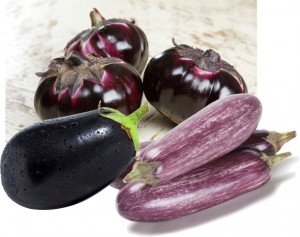
That’s right! Aubergines, or eggplant as they are more commonly called in Bermuda, are not a vegetable at all – they’re berries! The fruit is botanically classified as a berry and contains numerous small, soft seeds which are edible but bitter tasting. Eggplant grows very similar to tomatoes, hanging from the vines of plants that grow several feet in height. There are many different varieties of eggplant and the colours range from deep-purple, to lavender, green, orange, white and striped. The inside flesh of an eggplant is cream colored, spongy in consistency, and meaty in texture.
Eggplant belongs to the plant family of Solanaceae, also commonly known as nightshades, and are closely related to the tomato, bell pepper and potato. Unlike most fruits, it isn’t recommended eating eggplant without cooking it beforehand. Although eating raw eggplant is certainly not dangerous, the seeds do contain bitter tasting nicotinoid alkaloids. Like many other members of the nightshade family, eggplants are also related to tobacco. However, the amount of nicotine in eggplant is quite negligible. In fact, you would have to eat between 20 to 40 pounds of eggplant to equal smoking one cigarette.
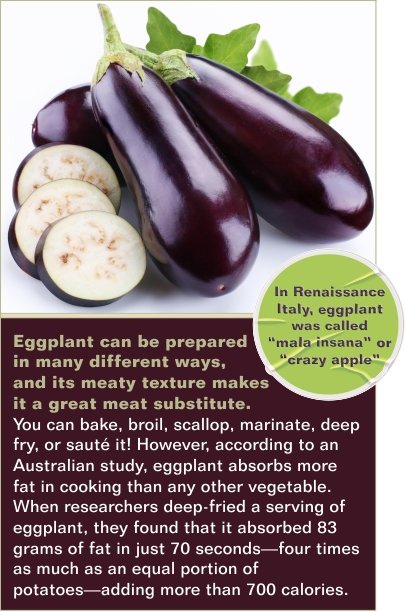
Eggplant becomes very tender when cooked and develops a rich, complex flavor. Salting and then rinsing the sliced eggplant (known as “degorging”) can soften and remove much of the bitterness of the seeds (some modern varieties do not need this treatment, as they have been hybridized to eliminate bitterness). In addition, the salting process will reduce the amount of oil absorbed during cooking as eggplant is capable of absorbing large amounts of cooking fats and sauces. Unless desired, peeling the skin of eggplant is not necessary as it is also edible.
Aubergine, or eggplant, is popular in many Mediterranean countries. The Greeks have a classic dish using eggplant called Moussaka. Moussaka is a casserole made by layering eggplant with a spiced meat filling then topping it off with a creamy bechamel sauce that is baked to golden perfection.
In Italy, Eggplant Parmesan is a staple of traditional Italian cooking. Originating from Southern Italy, Parmigiana di Melanzane, (as is called in Italian) is a casserole dish that uses fresh eggplants, tomato sauce, and mozzarella and parmesan cheese. The dish requires very few ingredients but it is a rich and satisfying recipe. Although typical eggplant parmesan dishes require the eggplant to be fried before layering, grilling eggplant makes it much healthier, and it’s just as tasty.
RECIPES: Grilled Eggplant Parmesan and Classic Greek Moussaka
Eggplant is a fat free, low-sodium food that is high in fiber and low in calories, and a good source of vitamin C, calcium and potassium. A one-cup serving of raw eggplant is only 20 calories!

Eggplants are extremely temperature sensitive, and can perish quickly in too warm or cold temperatures. Ideally, eggplant should be stored at 50°F which can be difficult to achieve in Bermuda’s climate. If you cannot use immediately after purchasing, store eggplant in the vegetable compartment of your refrigerator at 45 to 50°F. The vegetable compartment has higher humidity than other areas in the refrigerator and is preferred for eggplant storage. If storing in other areas of the refrigerator wrap eggplant loosely in plastic wrap. Use within 3-5 days of purchase.

• An eggplant is almost ninety-five percent water.
• Eggplant is native to Southern India and Sri Lanka.
• Common names for eggplant around the world are aubergine, eggplant, brinjal, garden egg, patlican, and guinea squash.
• The word “eggplant” comes from British-colonized India, where at the time, a small, white, egg-like variety of the vegetable was extremely popular.
• A Japanese proverb says, “The happiest omen for a New Year is first Mount Fuji, then the falcon, and lastly eggplant”.