

By Stephanie Simons,
Head Pharmacist,
Lindo’s Pharmacy in Devonshire
I’m sure we’ve all been encouraged (or ordered) at some point in our lives to: ‘Take your vitamins!’ And we’ve probably told our own children the same thing. Not to boast, but you may have noticed that we have a pretty impressive range of supplements in our pharmacy corner.
But what, exactly, do we know about these essential nutrients?
THEY’RE NEWER THAN YOU THINK…
The first vitamin pills first started popping up on pharmacy shelves from around 1916. One of the leading brands was Mastin’s Yeast Vitamon Tablets – which contained vitamins A, B, C, Calcium, Iron and ‘Nux Vomica’. Which sounds kind of scary – and was. A homeopathic remedy for heartburn, it was made from the seeds of the strychnine tree. Yes, that strychnine.
THE VITAMIN STAKES…
There were plenty of scientists who might claim to have discovered vitamins: a Japanese professor of agricultural chemistry called Umetaro Suzuki; an Englishman called Sir Frederick Gowland Hopkins and a Dutch doctor called Christiaan Eijkman.
But the ‘father’ of the vitamin is generally considered to be a Polish biochemist called Kazimierz Funk, who was born in Warsaw in 1884. Maybe because, in 1912, he came up with the name.
The son of two doctors – and Jewish (which helps to explain why he wound up relocating permanently to America in the 1940s) – he had hip dysplasia as a child. But there was nothing wrong with his brain: he set off for university in Switzerland at 16 and graduated with a PhD in organic chemistry at 20.
CHICKEN AND RICE…
In the early 1900s, Funk became fascinated by the work of Christiaan Eijkman.
The Dutchman, who was 26 years older than Funk, had been trying to find the ‘toxin’ responsible for beriberi – a common disease at the time which caused nerve damage and heart failure.
He did experiments on chickens, exposing them to the disease (don’t ask how) and sure enough, they all died. But when he got a new batch, and changed their diet, a strange thing happened. The chickens that ate white rice died. Again. But the ones that ate brown rice did not. And when some sick birds were given brown rice, they got better.
FUNK FOLLOWS THE TRAIL…
Picking up the beriberi baton, Funk did his own experiments – this time on pigeons. With the same results.
But unlike Eijkman (who remained fixated on the toxin theory), Funk began to think that beriberi was a ‘deficiency disease’. Something in the brown rice was protecting the birds; and its absence was making them sick.
In 1912, in a lab in London, Funk (who by this time had anglicised his name to ‘Casimir) found that something. He called it a ‘vitamine’: a mash-up of ‘vital’ and ‘amine’ (the name of a compound containing nitrogen).
Funk believed his ‘vitamine’ was B1 (thiamine). Turns out it was actually B3 (niacin). Which doesn’t cure beriberi. And isn’t an amine. But never mind: vitamin research was underway. And when it became obvious that not all vitamines were ‘amines’, that final ‘e’ was quietly dropped and they became plain old vitamins.
THE GANG’S ALL HERE… 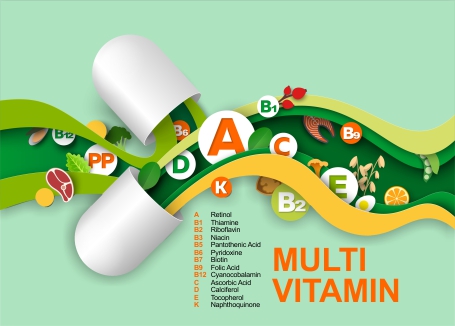
By 1948, the last of the ‘essential’ vitamins had been discovered. There are 13 in all: A, C, D, E and K – plus eight B vitamins. They were named roughly in order of discovery (though some of the Bs came limping in later, with B12 bringing up the rear).
Vitamin K is out of step because when scientists realised it was involved in blood clotting, they gave it the German name for coagulation (‘koagulation’). Which is lucky, since vitamin C was already taken.
VITAMANIA…
By the early 1940s, vitamins and supplements were not just on the scene – they were becoming household staples. Magazines like Good Housekeeping were promoting them. Advertisers extolled their powers (‘sunshine in a bottle!’) – and even President Franklin Delano Roosevelt got on the bandwagon. Concerned about the weediness of many GIs enlisting for service in the war in Europe, he encouraged awareness of the benefits of a balanced diet, including vitamins. Like most fads, it went too far – and in 1942 the term Vitamania was coined to describe the fashion for relying on pills and potions rather than good food, to stay healthy.
YUMMY GUMMIES…
The holy grail for vitamin manufacturers was to find some way of making their pills palatable.
Chewable vitamins arrived in the late 1960s – most popularly in the form of the Flintstones multivitamins. They looked cute but still tasted a bit meh.
The first gummy vitamins – Yummi Bears – were invented in 1997. Inspired by the Haribo Gummy Bears (created by German confectioners in Bonn in 1922), they were initially made with gelatine. But because that uses pig skin, the recipe was later tweaked – for ethical and dietary reasons – to use pectin instead.
Gummies were a game changer – so much so that today, they are the main way that Americans aged 35 and under get the vitamins, minerals and supplements they require. So, take your vitamins. And be glad your recommended daily allowance does not include Nux Vomica.
Stephanie Simons is the head pharmacist at Lindo’s Pharmacy in Devonshire. She earned her Bachelor of Science in Pharmacy at Massachusetts College of Pharmacy and has been practicing for over 20 years. She is a registered pharmacist with the Bermuda Pharmacy Council and is a member of the Bermuda Pharmaceutical Association.