

Nature is a great stress reliever. A walk along the beach, or around the Botanical Gardens (without checking your device every two seconds) can work wonders to restore your ‘joy’.

By Stephanie Simons,
Head Pharmacist,
Lindo’s Pharmacy in Devonshire
Welcome to Stress Awareness month. For most of us, stress – and being aware of it – is not something confined to April.
But what exactly IS stress? Can it ever be a good thing? And is there something we can do to combat it? (Spoiler alert: the answer is yes, and some helpful ‘weapons’ in this battle can be found right here in Pharmacy Corner.)
A BRIEF HISTORY
Stress has been around forever. We may think we live in stressful times – and we do. But historically, our ancestors had to deal with some pretty terrifying ‘stressors’, too, including attacks by wild animals.
But in those days, there wasn’t a name for it. ‘Stress’ is a shortening of ‘distress’; and back in the 1300s, it meant adversity. By the 1600s, ‘stress’ was being used by scientists to describe a force that could bend materials out of shape.
It was not till 1936 that an Austrian-born Hungarian scientist called Hans Selye, working out of McGill University in Canada, coined the term for humans.
The ‘Father of Stress’, as Selye became known, noticed in his days as a medical student in Prague that hospital patients shared certain symptoms, regardless of their illness. He had a hunch it was due to duress.
Later, at McGill, he did experiments on rats, subjecting them to more duress. This caused increased levels of hormones adrenaline and cortisol. And ulcers. So, he borrowed the term ‘stress’ from physics, to describe the ‘non-specific response of the body to any demand for change’.
In a bit of karma, perhaps, Selye himself came under pressure, late in his life, after suggesting smoking as a means of stressbusting – without revealing that he’d been funded by Big Tobacco.
IS STRESS A MENTAL ILLNESS?
No. Stress can be a cause of mental illness – leading to anxiety, depression or PTSD – and also a result of mental illness. But mostly it is a natural reaction to an incident. It’s only when it persists that it’s a problem.
 CAN STRESS EVER BE GOOD?
Yes. One type – ‘eustress’ – can be helpful, providing a burst of energy at crucial moments: when writing something on deadline, or giving a speech. Or in sporting competitions. It’s thrilling – like the feeling you get when riding a rollercoaster. And like a rollercoaster, it doesn’t last.
AND THE BAD KINDS?
In this category, we have Acute Stress – a one-off, ‘fight or flight’ response to a specific event (a car accident, a big argument). Our body pumps adrenaline and cortisol into the bloodstream, increasing our heart rate and our energy levels, so we can escape from – or deal with – the problem. If Acute Stress recurs, it becomes Episodic Acute Stress. We see this in folks with high pressure jobs like ER staff, for instance.
And finally, there is Chronic Stress, when our body’s engine is revving away indefinitely. This can put strain on our heart, depress our immune system, and wreak havoc on our digestion.
HOW CAN I TELL IF MY GOOD STRESS HAS GONE BAD?
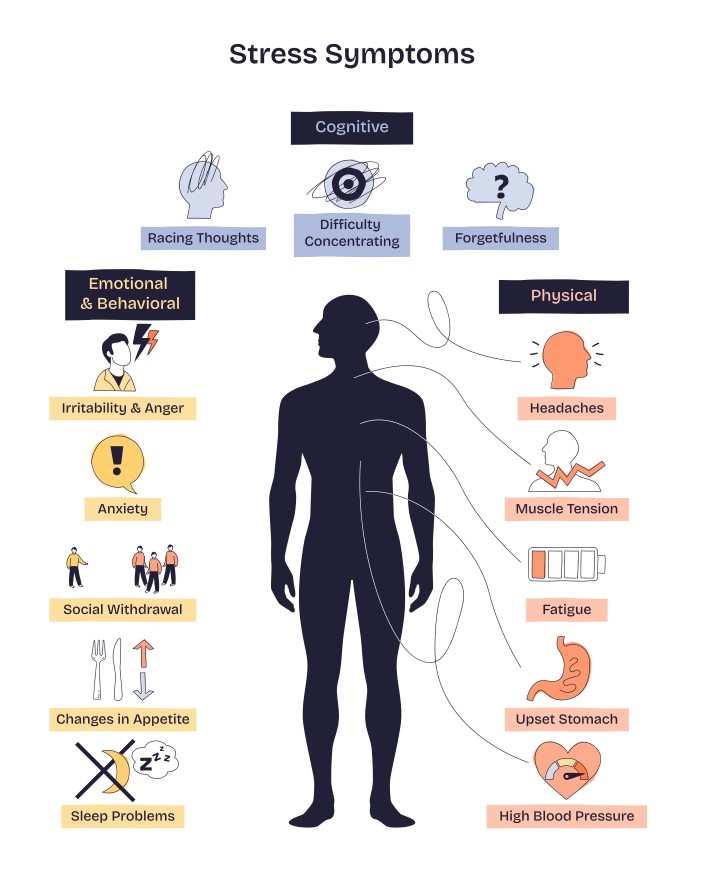
Constant irritability is one sign. A permanent state of dread is another. And, saddest of all, a ‘loss of joy’. Physical symptoms, like insomnia, digestive issues (loss of appetite) and exhaustion are also indicators. If they persist, you should talk to your GP.
WHAT CAN I DO ABOUT IT?!
Your doctor might recommend therapy or counselling.
But there are steps we can take on our own, too – and some of the tools we can use in the fight against stress can be found here, in Pharmacy Corner. Exercise is a great stressbuster, releasing endorphins into our system which help us to feel better.
A good night’s sleep is crucial, too. Here in the pharmacy, we have all sorts of sleep aids, from melatonin gummies to herbal bedtime teas. There are also supplements, for when you are feeling overwhelmed. Olly’s Goodbye Stress gummies are designed to restore calm, when you feel like life is getting on top of you.
Nature is a great stress reliever. A walk along the beach, or around the Botanical Gardens (without checking your device every two seconds) can work wonders to restore your ‘joy’.
Many people swear by aromatherapy. Lavender oil, used in a diffuser, or diluted in a ‘carrier oil’ and used for massage or in a bath, is soothing. (Although concentrated essential oils should never be applied directly to the skin.) Check out our selection the next time you pop in.
Stephanie Simons is the head pharmacist at Lindo’s Pharmacy in Devonshire. She earned her Bachelor of Science in Pharmacy at Massachusetts College of Pharmacy and has been practicing for over 20 years. She is a registered pharmacist with the Bermuda Pharmacy Council and is a member of the Bermuda Pharmaceutical Association.