

By Stephanie Simons,
Head Pharmacist,
Lindo’s Pharmacy in Devonshire
February is Children’s Dental Health Month. Dentists recommend that you start brushing your child’s teeth – very gently, obviously – as soon as the first milk tooth pops through the skin. Usually at about six months.
But some experts believe you can start the process even earlier – on the grounds that good oral hygiene doesn’t need teeth. Whatever you feel on that subject, here’s some suggestions and tips for you to chew over…
INFANTS
There is a school of thought that says that even before your baby gets his or her first milk tooth, you should wipe their gums gently twice a day – either with a soft (clean!) cloth, a bit of gauze or a ‘baby finger toothbrush’ (a bristled silicone sheath that slips over your finger – and looks a bit like a spiky Dalek). No need for toothpaste at this stage – water is fine.
What’s the point of this, I hear you ask? Well, wiping the gums gets rid of any lingering bacteria from leftover milk or formula. It helps your baby get used to the brushing process. And it may also feel good, if they are teething. (And on that front, we can help, too: we stock several cooling gels including Orajel and Bonjela, to soothe your little one’s discomfort.)
6 MONTHS – 3 YEARS
Once baby’s first tooth does appear, you can move on to proper brushing. You’ll need a baby toothbrush – which we stock (and which needs to be replaced every 3-4 months). Something with a small head – to fit in their small mouth – rounded edges and soft bristles. Oh, and a handle that YOU find comfortable – because you’ll be doing the driving.
Use a tiny smear of children’s toothpaste – a ‘rice-sized’ blob, of a brand that offers at least 1000 ppm of fluoride. Fluoride is important because it helps to protect against decay and strengthen the brand-new enamel of those tiny teeth, while they are at their most vulnerable and exposed.
It may seem obvious, but let’s say it anyway: don’t let your child eat the toothpaste. Fluoride may be great for milk teeth, but it’s not great for tummies. We also stock fluoride-free toothpaste for small children like Tom’s and Punch and Judy, so that you don’t have to worry the toothpaste being sucked in and swallowed.
Remember the dentist’s golden rule: 2-2-2 (which applies to grown-ups, too). Brush TWICE a day (with the second brushing coming just before bedtime), for TWO minutes a time. And visit the dentist TWICE a year.
3-6 YEARS
Carry on with the 2-2-2 rule and brush at least twice a day – for two minutes, no skimping! – with one of those sessions occurring just before bed.
By the age of three, your child can probably handle an electric or battery-operated toothbrush – although the old-fashioned kind is just fine, too. If you do go electric, make sure it’s one recommended for children, with a soft bristled head. You don’t want an adult model which could be too powerful and inadvertently cause harm.
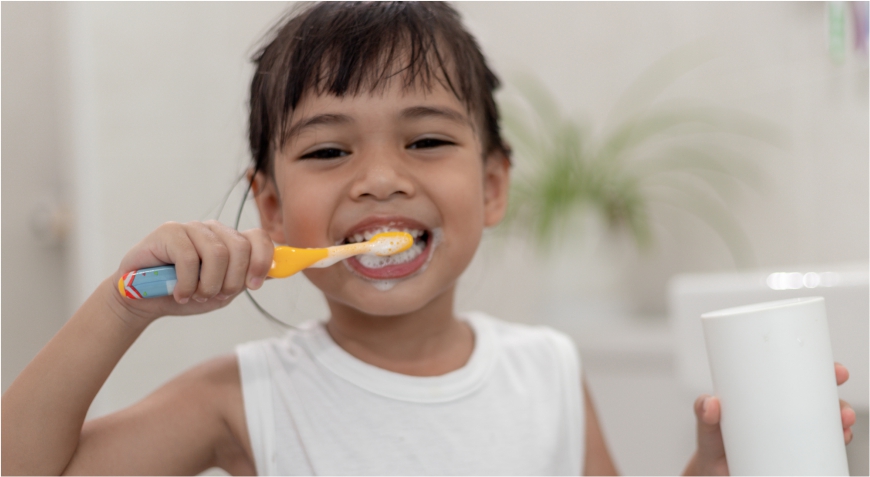
Whatever kind of toothbrush you’re using, start to encourage your child to brush their own teeth…under your watchful gaze. News flash: you’re STILL the toothbrush monitor and will be till they are seven.
Use a tiny bit more toothpaste on the brush – a pea-sized blob, rather than a rice-sized smear – of your preferred children’s fluoride brand. Most major brands stock fun versions for kids – like Crest Advanced Kid’s Fluoride Toothpaste, which comes in bubblegum flavour, and changes colour from blue to pink, to encourage longer brushing.
Remind them to spit, not rinse. Rinsing means all that helpful fluoride goes right down the drain, literally – and still no eating, despite the bubblegum taste! Continue to replace your child’s toothbrush (or toothbrush head) every 3-4 months.
Once he or she gets enough teeth so that some are starting to touch, you can introduce flossing. Again, you’ll have to be the designated flosser, so be sure to use a light touch.
We have a number of suitable dental flosses in store, so if you need help, just ask one of our pharmacists for advice.
7 YEARS AND UP
By now, your child should be able to brush his or her own teeth – though you will still need to keep an eye on proceedings, to make sure they don’t cut corners.
You’ll also need to start buying a higher fluoride toothpaste – 1350-1500 ppm – to protect against cavities. Flossing will become important, too; since teeth may start to get crowded.
If your child wants to try using a mouthwash, a non-alcohol version with fluoride is OK (though not for younger kids, who might swallow it). But remember not to use mouthwash AFTER toothbrushing. Like rinsing after brushing, this will undo the good work that your toothpaste is doing (the fluoride in mouthwash is no match, in terms of protection, for that in toothpaste). Perhaps try using it in between the morning and evening brushing sessions.
Stephanie Simons is the head pharmacist at Lindo’s Pharmacy in Devonshire. She earned her Bachelor of Science in Pharmacy at Massachusetts College of Pharmacy and has been practicing for over 20 years. She is a registered pharmacist with the Bermuda Pharmacy Council and is a member of the Bermuda Pharmaceutical Association.