

Morning sickness is very common in pregnancy and usually occurs between the 4th and 7th week.

By Stephanie Simons,
Head Pharmacist,
Lindo’s Pharmacy in Devonshire
PREGNANCY is a weird and wonderful time. Wonderful, because…you’re having a baby! Weird, because your body – which normally answers only to you – suddenly answers to something the size of an olive.
Luckily, your friendly neighbourhood Pharmacy Corner can help with many of the annoying little things that can make this time seem less like ‘blooming’ and more like ‘blooming hell’.
Naturally, if you have any doubts or worries about taking or using anything during your pregnancy, check with a medical expert. Our pharmacists are always happy to help; and you can (and should) also speak to your doctor if you have any concerns.
BLOOMING MARVELLOUS
Doctors recommend that pregnant women (and those trying to conceive) take 400 micrograms of folic acid a day, until the 12th week of term. Why? Because it’s important for the healthy development of your baby’s brain and spinal cord.
Folic acid is found naturally in dark green leafy veg (like spinach and kale…found right outside our pharmacy corner in the fruit and veg aisles). But to get 400 micrograms you need a lot of kale (five cups of the cooked stuff).
Why not have a look at our supplements aisle? Vitabiotics’ Pregnacare range provides folic acid – and vitamin D, which in small doses is also important (for healthy bones and teeth). Olly’s Prenatal gummies are another good way to make sure that you, and your growing baby, are getting everything you need.
Do ask a pharmacist, though, before you start popping lots of pills and potions. Some vitamins – such as Vitamin A – are not good for mom or baby. Err on the side of caution!
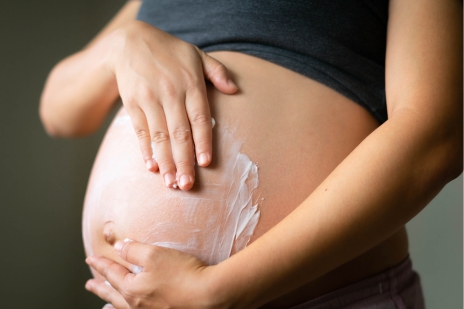
Hydration is key when treating stretch marks during pregnancy. Opt for a moisturiser that is formulated for sensitive skin and safe for use during pregnancy.
MORNING SICKNESS
In the early stages of pregnancy, one in three women will experience nausea and sickness. Scientists at Cambridge University think this is caused by your unborn baby producing a hormone called GDF15. This is already present in our bodies – but in much smaller amounts than your little bundle of joy is now pumping out into your system.
The result? Big-time nausea. Usually this will disappear by the 20th week – though in some women it will continue, and be so extreme that medical attention is needed, to stop mother and baby from becoming dangerously dehydrated. That condition is called hyperemesis gravidarum and luckily it is pretty rare.
If your ‘morning sickness’ (which can actually strike at any time of the day, worse luck) is unpleasant but not dangerous, your doctor may prescribe an antiemetic (anti-nausea) pill. This works by blocking the neurotransmitter receptors in the brain and stomach which, when triggered, make you feel sick. (In the same way an antihistamine blocks the neurotransmitter receptors that cause allergic reactions.)
Otherwise, you can try to quell those queasy feelings by using…ginger. Yes, when we were growing up, our moms sometimes used to give us ginger ale when we felt nauseous.
And it turns out it’s not just an old wives’ tale. Ginger does seem to have properties that can help soothe the savage stomach. Britain’s NHS guidelines recommend that if you have mild morning sickness, you could try sipping ginger tea, nibbling on ginger biscuits – or (kudos Mom) nursing a ginger ale. Here in Pharmacy Corner, we have a number of supplements containing ginger, such as Gravol Ginger Lozenge or Dramamine Natural, which might be worth checking out, too.
INDIGESTION
This is a big issue for a lot of moms-to-be. Again, some of it is down to hormones – which are relaxing muscles all over your body, including those in your digestive system…allowing acid reflux to occur. And some is down to the simple fact that your baby is taking up more and more space as it grows…and pressing against your stomach. Net result: indigestion.
There are lots of tricks for dealing with this: have lots of little meals rather than one or two whoppers. Sit up straight while you are eating; and afterwards, while you are digesting.
Prop yourself up slightly in bed when you settle down for the night (a prime time for indigestion to strike). Or try to sleep on your left side. Gravity is your friend here, for once. If you lie on your left side, your stomach is below your oesophagus – and it’s harder for stomach acid to back up and cause trouble.
If you’re still feeling uncomfortable, ask your pharmacist to recommend an antacid that is safe for pregnant women. There are lots! And make sure you follow the instructions, when it comes to dosage.
THE NINE MONTH STRETCH
Stretch marks. Not everyone gets them, but they are unsightly. And there’s not much you can do about them, until after you’ve had your baby.
But massaging your baby bump won’t hurt. It may help to ease feelings of tightness. And it could also help you and your partner bond with the new addition to your family.
Medical experts recommend you hold off until the third month. And keep your strokes soft and light – particularly toward the end of your pregnancy.
Choose a gentle cream or oil. Something containing vitamin E is good, because that will soothe any itchiness you may be feeling.
Many big-name brands – like Palmer’s or Vaseline – do their own belly bump formulas. There’s Palmer’s Stretch Mark cream and Bio-Oil is also excellent for stretch marks and scars.
You can also use a gentle carrier oil, like jojoba or sweet almond (we have a good selection in store. But please check with your doctor or one of our pharmacists if you want to add aromatherapy oils, because not all are safe for pregnant moms.
Stephanie Simons is the head pharmacist at Lindo’s Pharmacy in Devonshire. She earned her Bachelor of Science in Pharmacy at Massachusetts College of Pharmacy and has been practicing for over 20 years. She is a registered pharmacist with the Bermuda Pharmacy Council and is a member of the Bermuda Pharmaceutical Association.