
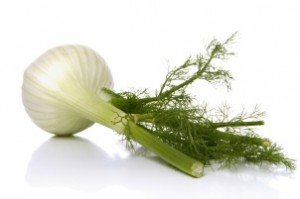
The Florence Fennel cultivar is entirely edible.
So often, fennel is confused with the heavy licorice flavour of anise partly due to many markets frequently mislabeling the vegetable as “sweet anise”. In fact, anise and fennel are quite different. Anise, or aniseed as it is sometimes called, is actually a flowering plant or herb, while “sweet anise”, or the Florence fennel cultivar, is a hearty vegetable with a thick, bulbous base, hollow celery-like stems, and topped with small feathery leaves. While fennel does share an aromatic compound called anethole that is also found in anise and star anise, fennel has a sweeter, more delicate flavor that enhances other foods rather than overpowering them.
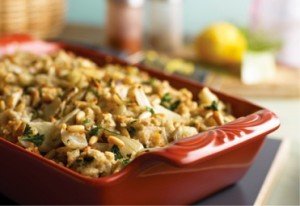
Fennel is a wonderful accompaniment to lamb dishes. Try this Roasted Fennel with Lemon Stuffing from Campbell’s Kitchen.
All parts of the Florence fennel are edible, and the bulb, foliage, and seeds of the fennel plant are widely used in many of the culinary traditions of the world. Fennel leaves are delicately flavoured and their feathery appearance is quite similar to dill. The bulb is a crisp vegetable that can be sautéed, stewed, braised, grilled, or eaten raw. Dried fennel seed is an aromatic, anise-flavoured spice and is harvested from common fennel. The seeds are commonly used to season sausages, breads, and meat stews, or ground to use as a rub on pork, lamb or fish dishes. Ground fennel seeds are often used in India and Pakistan to flavour curries, and the spice is a key ingredient in Chinese five-spice powders.
Fennel is low in calories and fat-free, and according to the World’s Healthiest Foods website, is surprisingly full of nutrients. A one cup serving of raw fennel contains vitamin C, folate, molybendum, manganese, potassium, calcium, copper, iron, magnesium, phosphorous and vitamin B3, or niacin or about 17 percent of the daily value of Vitamin C; 10 percent of the daily recommended value of potassium; and 4 percent daily value of calcium. A one cup serving also contains smaller amounts of minerals selenium and zinc and vitamins A, B1, B2, B5 and B6. And, because fennel contains the anise tasting phytochemical anethole, which has been shown to reduce inflammation and acts to prevent cancer, it can also be classified as a rich source of antioxidants.
Fennel has long been used in folk medicine, specifically the seeds, to relieve indigestion, as a natural diuretic, and even as a breath freshener. In fact, some natural toothpastes contain fennel.
BUYING FENNEL
When choosing fresh fennel, look for ones that have clean, firm and solid bulbs. Fresh fennel should be fragrant with a mild licorice smell. Bulbs should be a pale green colour, while the stalks and leaves should be a brighter green, and the leaves should look fresh and not wilted.
STORING FENNEL
Fresh fennel should be wrapped in plastic and stored in the crisper drawer of your refrigerator to be used within 3 to 4 days. Do not wash fennel before storing, as the added moisture could cause the bulb and leaves to go soggy. While fennel can also be blanched and frozen, it will lose some flavour.


