
The feel good song “Walking on Sunshine” was originally performed by 80’s pop stars Katrina and the Waves, and we think it is appropriate because helping the environment sure makes us “feel good”! There’s nothing more satisfying than knowing we have contributed a little bit to reducing our carbon footprint.
In May 2011, Lindo’s Group of Companies installed a photovoltaic (PV) system on the roof of our Devonshire store in an effort to reduce the environmental impacts of fossil fuel consumption. The project, undertaken by Alternative Energy Systems (AES) (Bermuda) Ltd, primarily focused on the long-term environmental benefits of harnessing the power of the sun, and to date those benefits are already adding up!
“The results are what we were hoping to achieve, in terms of what we could do for the environment” – Zach Moniz, Manager Lindo’s Family Foods
In the past 12 months, the 141,116 kWh of renewable energy produced by our solar power system has improved air quality by avoiding carbon dioxide emissions by an estimated 223,374 pounds, nitrogen oxide emissions by 360.55 pounds, and sulfur dioxide by 832.73 pounds – all are harmful gases that contribute to global warming. The savings also add up in reducing environmental impacts. Our system conserved approximately 2,598 trees (grown for 10 years), saved 233,331 car miles not driven, and conserved crude oil by 273 barrels.
Each 100 kWh generated by our photovoltaic system conserves 1.8410 trees, 165.3467 miles not driven, 0.1936 barrels of crude oil, and avoids 158.2947 pounds of carbon dioxide emissions, 0.2555 pounds of nitrogen oxide emissions, and 0.5901 pounds of sulfur dioxide emissions.
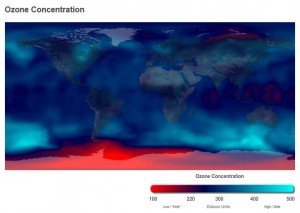
Real-time data imagery of ozone concentrations from NOAA – September 24, 2012.
DID YOU KNOW? The process of burning fossil fuels releases a variety of gases and particulates. In any combustion, carbon dioxide (CO2) and water (H2O) are released, but when fuels containing nitrogen are burned (such as fossil fuels), nitrogen dioxide (NO2) is also released. Nitrogen dioxide is a toxic compound, often associated with an orange-brown color, and is a major air pollutant, especially in industrial areas. In the lower atmosphere (the troposphere), NO2 is responsible for the formation of ozone (O3). While stratospheric O3 (upper atmosphere) protects the Earth from harmful ultraviolet energy, tropospheric O3 causes many health and breathing difficulties. The National Oceanic and Atmospheric Administration (NOAA) monitors global NO2 concentration using the GOME-2 sensor onboard the MetOp-A satellite launched by the European Space Agency. To view real-time images of the Earth’s ozone concentrations and other climate data click here.